
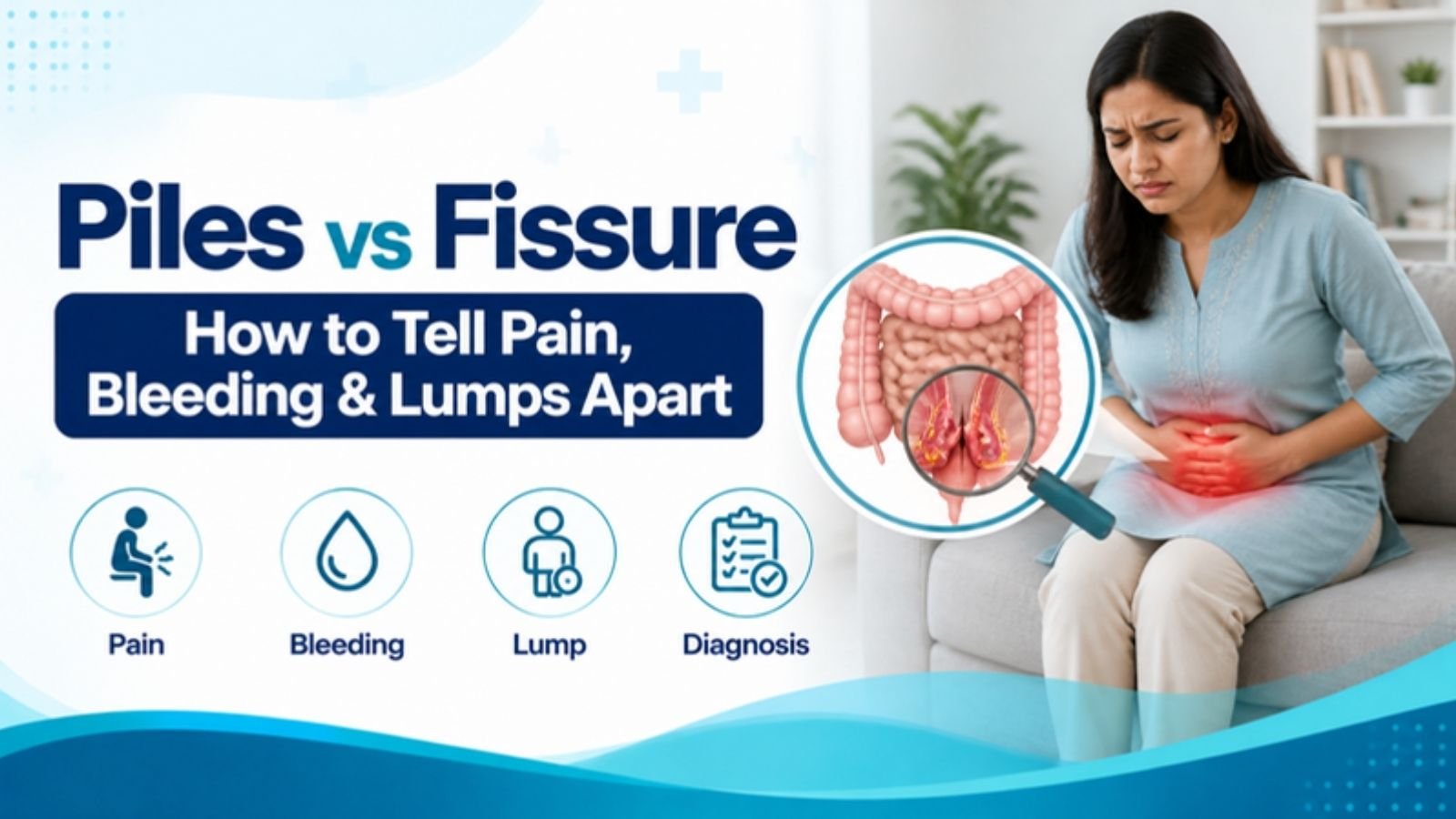
Both can cause bleeding near the anus, but the type of pain, the amount of blood and the kind of lump tell them apart. Here is how to recognise piles, fissure and fistula, and why the right diagnosis matters.
You see blood in the toilet after passing stool and assume it’s piles. You buy an ointment from the pharmacy, but the sharp pain doesn’t settle. Weeks later, you learn it was a fissure all along, and that you never knew the difference between piles and fissure.
The mix-up is very common, because both conditions affect the same small area and both are linked to constipation and straining. Constipation alone affects about 22% of Indian adults, so millions of people are at risk of one or both problems. Knowing the difference between piles and fissure helps you get the right treatment sooner, and avoid weeks of using the wrong cream.
What Are Piles?
Piles, also called haemorrhoids, are swollen blood vessels in and around the anus. Everyone has these blood vessel cushions, but they can swell and cause symptoms. Piles can be:
Internal piles
inside the anal canal and usually painless. They may bleed or slip out during a bowel movement.
External piles
under the skin around the anus. They can become painful if a blood clot forms inside them.
Common symptoms of piles include:
- Bright red bleeding after passing stool
- Itching around the anus
- A lump around the anus
- Mucus in your underwear or on the toilet paper
- A feeling that your bowel has not emptied fully
Factors that make piles more likely include constipation, straining, heavy lifting, pregnancy, older age and being overweight. To spot problems early, read our guide on 7 early warning signs of piles.
What Is an Anal Fissure?
An anal fissure is a small tear or cut in the lining of the anal canal. The tear exposes sensitive nerve endings, so the pain is sharp and intense. Common symptoms include:
- Pain during and after bowel movements that can last for hours
- Bright red blood on the stool or tissue
- A visible crack or tear near the anus
- A small skin tag in long-standing cases
The most common cause is passing a hard or large stool. Other causes include severe diarrhoea and childbirth. The type of pain is the biggest difference between piles and fissure.
What Is an Anal Fistula?
Many people confuse a fistula with piles and fissures too. An anal fistula is a small tunnel between the inside of the anal canal and the skin outside. It usually forms after an infection or abscess near the anus. The main sign is a discharge of pus or fluid that keeps coming back, often with swelling and pain.
Difference Between Piles and Fissure: Symptoms at a Glance
| Sign | Fissure | Piles | Fistula |
|---|---|---|---|
| Pain | Sharp, cutting, can last hours | Often mild or none | Throbbing, worse when sitting |
| Blood | Streak on stool or tissue | May drip into the toilet | Pus, sometimes with blood |
| Lump | Small skin tag if chronic | Soft lump that may come out | Small opening near the anus |
| Itching | Mild | Common | Common, due to discharge |
| Discharge | Rare | Mucus | Pus that keeps returning |
| Main cause | Hard stools, straining | Straining, pregnancy, heavy lifting | Infection or abscess |
How to Identify Piles or Fissure: Four Questions
Ask yourself these questions to understand the difference between piles and fissure before your doctor’s visit:
- Does it feel like passing broken glass? Sharp, cutting pain during and after bowel movements strongly suggests a fissure. Painless bleeding is more typical of internal piles.
- How much blood do you see? A thin streak on the stool or tissue points to a fissure. Blood that drips or splashes into the toilet is more common with piles.
- Do you feel a soft lump that slips out and goes back? A soft swelling that comes out during a bowel movement and returns on its own is typical of piles. A firm skin tag at the back of the anus may be a sign of a chronic fissure.
- Is there pus or a wet discharge? Ongoing discharge, with swelling that keeps coming back, suggests a fistula.
These questions help you describe your symptoms clearly. They cannot replace an examination.
Why Self-Diagnosis Is Risky
Not knowing the difference between piles and fissure leads many people to treat themselves with piles creams when they actually have a fissure. Piles creams do not relax the tight anal muscle that keeps a fissure from healing. The tear lingers, and about 40% of acute fissures go on to become chronic.
Bleeding from the back passage can also come from other conditions, such as polyps or inflammatory bowel disease. Fissures that sit on the side of the anus can point to conditions such as Crohn’s disease or tuberculosis. A doctor can usually tell the difference in a few minutes with a gentle examination and, if needed, a proctoscopy.
- Using piles creams for a fissure
- Mistaking a fissure skin tag for a pile
- Ignoring bleeding because “it’s just piles”
- Delaying a check-up out of embarrassment
- Stopping treatment as soon as the bleeding stops
Who Is More at Risk?
For Women
For Men
Long hours of sitting, heavy lifting at the gym or at work, and low water intake are common triggers. Heavy lifting is a known risk factor for piles, while hard stools from low fibre intake are the main cause of fissures.
For Office Workers
Desk jobs, long commutes and late dinners slow digestion and lead to constipation. Constipation raises the risk of both piles and fissures. Short walking breaks, a water bottle at your desk and an early dinner help protect you from both.
How Doctors Confirm the Difference Between Piles and Fissure
A short visit is usually enough to tell piles and a fissure apart.
- History: Your doctor asks about the type of pain, the amount of bleeding, any lump, and your bowel habits.
- Gentle examination: A fissure can often be seen just by gently parting the skin near the anus. External piles and skin tags are also visible.
- Proctoscopy: A small, lubricated instrument lets the doctor look inside the anal canal for internal piles. If you have a painful fissure, this step may be delayed until the pain settles.
- Further tests if needed: If bleeding could have another cause, your doctor may suggest a colonoscopy.
Most patients leave the first visit with a clear diagnosis and a treatment plan.
Home Care That Helps Both Piles and Fissure
Because constipation drives both conditions, the same daily habits help with both:
- Add fibre to every meal with whole grains, dal, vegetables and fruit.
- Drink 8–10 glasses of water a day.
- Go to the toilet as soon as you feel the urge, and keep toilet time under five minutes.
- Don’t strain. Rest your feet on a small stool to make passing stool easier.
- Take a warm sitz bath for 10–15 minutes after bowel movements.
- Avoid heavy lifting during a flare, and walk for 30 minutes a day.
These steps ease symptoms and lower the risk of both problems returning.
Doctor, Which Is More Dangerous: Piles, Fissure or Fistula?
None of the three is usually life-threatening, but all three can get worse without care.
- Piles can grow larger, slip out, bleed more or form painful clots. Read do piles go away on their own to know what to expect.
- Fissures can turn chronic, form skin tags and sometimes get infected.
- Fistulas rarely heal without a procedure and can cause repeated infections. Of the three, a fistula usually needs the most active treatment.
Can You Have Both Piles and Fissure?
Yes. Constipation and straining cause both conditions, so they often appear together. In that case, your treatment plan will cover both problems. In suitable cases, laser treatment can treat piles and a fissure in the same sitting.
How Treatment Differs
The difference between piles and fissure also shows in how each one is treated.
Fissure
The goal is to heal the tear and relax the tight anal muscle. Guidelines recommend fibre and warm sitz baths first, then prescription ointments. Chronic cases may need laser fissure treatment.
Piles
The goal is to shrink or remove the swollen blood vessels. Early piles respond to diet changes and medicines. Advanced piles may need laser piles treatment.
Fistula
The goal is to close the tunnel and prevent new infections. Most fistulas need a procedure such as laser fistula treatment.
All three laser procedures are done as daycare treatments with quick recovery.
When to Seek Professional Help
See a doctor if bleeding lasts more than a few days, if pain is severe, or if you notice a lump, pus or fever. Any bleeding from the back passage after the age of 45, or with a change in bowel habits or weight loss, should always be checked.
If you are looking for piles or fissure treatment in Bangalore, contact our team for a clear diagnosis and a personalised plan.
Why guess at the cause of your pain when a five-minute examination can tell you for certain?
Conclusion
The difference between piles and fissure comes down to a few clear signs. Piles usually bleed more and hurt less. A fissure hurts more and bleeds less. A fistula leaks pus. Note your symptoms. Avoid self-treating with the wrong cream. Get examined early. The right diagnosis is the fastest route to relief.
Frequently Asked Questions
What is the main difference between piles and fissure?
Piles are swollen blood vessels in and around the anus and usually bleed more and hurt less. A fissure is a small tear in the anal lining that causes sharp, cutting pain during and after bowel movements, usually with a thin streak of blood.
Can I have both piles and fissure at the same time?
Yes. Constipation and straining cause both conditions, so they often appear together. In suitable cases, laser treatment can treat piles and a fissure in the same sitting.
Can I use a piles cream for a fissure?
It is not a good idea without a diagnosis. Piles creams do not relax the tight anal muscle that keeps a fissure from healing, so the tear can linger and become chronic.
How does a doctor tell piles and fissure apart?
Usually in a single short visit, through your history, a gentle examination and, if needed, a proctoscopy. Most patients leave the first visit with a clear diagnosis and a treatment plan.
Sources
- Piles (haemorrhoids) – NHS
- Anal Fissure – Cedars-Sinai Health Library
- Lyle V, Young CJ. Anal fissures: An update on treatment options – Australian Journal of General Practice, 2024
- Management of Anal Fissures: ASCRS Guidelines – American Family Physician, 2024
- 22% of Indian adults suffer from constipation – Abbott Gut Health Survey
Medical Disclaimer: This blog is for awareness only and does not replace a doctor’s consultation.
Not Sure if It Is Piles or Fissure?
A short examination gives you a clear answer. Consult Dr. Varun Kumar J, Laser & Laparoscopic Surgeon in Bangalore.
